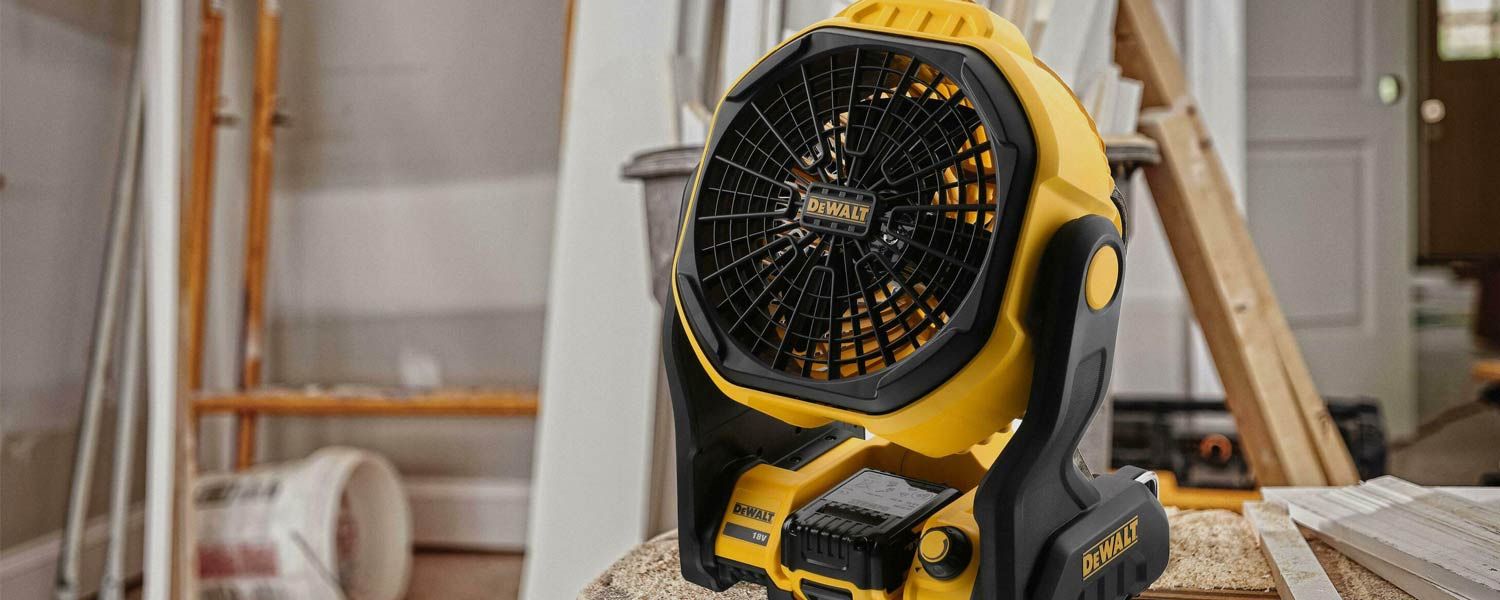
Cordless site fan: cooling and dust displacement on the job site
A cordless site fan is a practical tool for targeted cooling on hot working days and accelerating drying processes during painting or plastering. However, an open fan is no substitute for active dust extraction. If you direct a powerful airflow at fine demolition dust or sanding dust, you will disperse the dust throughout the entire room, leading to serious health risks.
For a safe workspace, use a mobile fan to supply fresh air or to stimulate the evaporation of construction moisture. Capture airborne dust directly at the source with a certified construction vacuum. In this article, you will learn where a cordless fan pays off, how to prevent dust disturbance, and what to look for when choosing a model within your 18V or Nuron battery platform.
Contents
- What a cordless fan can and cannot do
- Dust displacement versus dust extraction: safety regulations
- Accelerating building drying with air circulation
- Selection criteria for a cordless fan
- Comparison: open site fan versus axial fan with ducting
- Common mistakes on the job site
- Frequently asked questions
What a cordless fan can and cannot do
A fan does not actively cool the air in a room the way an air conditioning unit does. The temperature on the thermometer remains the same. The cooling effect occurs because the airflow moves across your body, causing sweat to evaporate more quickly. This reduction in perceived temperature makes heavy physical work in enclosed spaces or under an uninsulated roof considerably more bearable.
In addition, continuous air movement helps break up heat accumulation. In attics or recently enclosed shells of buildings, heat often remains trapped under the ceiling. By directing a fan upwards or toward an open window, you initiate natural ventilation currents.
Do not place the fan directly next to your workspace on its highest setting. Instead, direct the airflow obliquely past your body or off an adjacent wall. This allows you to experience continuous cooling without an unpleasant draft in your eyes or on your neck.
Dust displacement versus dust extraction: safety regulations
The greatest risk of an open cordless site fan is blowing up settled dust. During renovation and construction work, hazardous silica dust is often generated when cutting, grinding, or chiseling into masonry and concrete. This fine dust remains suspended invisibly in the air for long periods.
Occupational health and safety regulations dictate that respirable silica dust must be extracted at the source as much as possible to keep exposure within applicable limits. Do not blow away demolition dust or grinding residue with an open fan. Doing so disperses the finest particulate matter throughout the entire building, causing you and your colleagues to inhale the residue hours later.
An open fan does not filter air and does not eliminate health hazards. Whenever possible, connect power tools directly to a suitable dust extractor with an M- or H-class certification. Only use an open fan once the room has been thoroughly vacuumed and cleaned.
If you must ventilate a dusty room while no work is taking place, position the fan near an open window or exterior door and direct the airflow outside. This creates slight negative pressure and gradually exhausts stagnant, dusty air to the outdoors.
Accelerating building drying with air circulation
Alongside personal cooling, assisting with building drying is a major function of portable fans. After plastering or pouring a screed, hundreds of liters of moisture remain trapped in walls and floors. Moisture evaporates more slowly when the layer of air directly against the surface becomes saturated with water vapor.
By directing a fan along damp walls, you disrupt this saturated boundary layer. The drier ambient air can then absorb moisture from the building materials once again.
Keep the following guidelines in mind:
- Combine ventilation with dehumidification: Merely circulating air does not remove moisture; the humidity remains trapped in the room. Combine ventilation with a condensation dehumidifier or ensure controlled exhaust to the outside.
- Prevent shrinkage cracks: Do not aim a strong airflow directly at fresh plaster during its first hours of curing. Allow the material to set naturally before introducing active air movement.
Selection criteria for a cordless fan
When purchasing a mobile fan, power supply, airflow volume, and build quality play a decisive role.
1. System compatibility and bare tool options
Almost all manufacturers offer fans as bare tools (without battery and charger). Preferably choose a model within your existing 18V platform (such as Makita LXT, DeWalt XR, Milwaukee M18) or 22V platform (such as Hilti Nuron). This enables you to use the batteries already in your van, significantly reducing purchase costs.
2. Hybrid power supply (AC/DC)
Many professional models feature hybrid operation. This means you can run the fan cordlessly on an 18V battery while on scaffolding, but can also plug it into mains power (230V) using an adapter. This is practical when you want to leave the unit running overnight to dry plaster.
3. Airflow volume and air speed
A fan’s airflow rate is expressed in cubic meters per hour (m³/h). For targeted personal cooling at a distance of a few meters, a compact model with an airflow between 300 and 600 m³/h is usually more than sufficient. If the unit needs to circulate air across an entire floor to support a building dryer, choose a larger model with a rating of 800 to over 1,200 m³/h.
4. Runtime on a full battery
Actual runtime depends heavily on the selected speed setting:
- Low setting: Often sufficient for continuous air circulation during drying or light tasks. A standard 5.0 Ah battery typically delivers 8 to 15 hours of operation here.
- Medium setting: Provides a good balance between airflow and noise levels. Expect 4 to 7 hours of runtime on a 5.0 Ah battery.
- High setting: Maximum air speed for immediate heat relief. A 5.0 Ah battery is often depleted after 1.5 to 3 hours at full power. For a full working day at maximum output, larger battery packs (such as 8.0 Ah or higher) or spare batteries are recommended.
5. Dust resistance and motor design
Job sites are always prone to airborne sand, gypsum, and cement. Preferably select a tool with a Brushless motor and a housing with an adequate ingress protection rating (such as IP54). A sealed motor housing prevents fine sanding dust from penetrating, which prevents bearing wear and short circuits.
Comparison: open site fan versus axial fan with ducting
Different situations on the job site require different types of ventilation. The table below shows when an open cordless fan is adequate and when a ducted axial fan is necessary.
| Feature / Application | Open site fan (cordless / hybrid) | Axial fan with ducting (mains powered) |
|---|---|---|
| Primary function | Personal cooling & air circulation | Targeted dust extraction & fresh air supply |
| Power supply | 18V / 22V battery or hybrid (adapter) | Typically 230V mains power |
| Airflow volume | Approx. 300 – 1,500 m³/h | Approx. 1,500 – 4,000+ m³/h |
| Dust management | Unsuitable for extraction; stirs up dust | Suitable via ducting and optional M-/H-class filter bags |
| Portability | Compact, instantly movable, lightweight | Heavier, requires duct routing to the outside |
| Suitability for drying | Suitable along walls and ceilings | Highly powerful for large volumes |
Common mistakes on the job site
Incorrect fan deployment frequently causes errors and additional work on site. Pay attention to the following pitfalls:
- Turning on the fan after demolition work: Do not switch on the fan while a thick layer of dust still covers the floor. Vacuum the floor thoroughly first with a professional dust extractor. If you fail to do this, the fan will kick the fine dust back into the air, where it will settle on freshly painted surfaces.
- Insufficient ventilation openings during drying: Running a fan in a completely sealed room without a dehumidifier is ineffective. The air rapidly becomes saturated with moisture, bringing the drying process to a halt. Crack open windows or install a condensation dehumidifier.
- Exposing the machine to driving rain: Although professional cordless fans are built to be robust, most models cannot withstand heavy downpours. Check the IP rating in the user manual before leaving the machine outdoors on scaffolding.
- Vibrations on smooth surfaces: On the highest setting, motor vibration can cause some models to creep across smooth concrete or tiled floors. Check that the rubber feet are clean, or use the integrated hanging hooks to secure the fan firmly to a beam or scaffold tube.
Frequently asked questions
Can a cordless site fan lower the indoor temperature?
No. A fan only moves air; it does not cool down the room itself. The human body cools down because sweat on your skin evaporates faster in the airflow, resulting in a lower perceived temperature. To physically cool a room, you must introduce cooler outdoor air or deploy a portable air conditioner.
Is an open fan safe to use while sanding?
No. Sanding releases fine dust particles. An open fan immediately scatters this dust across the entire room, increasing the concentration of suspended airborne matter. Connect your sander directly to an appropriate dust extractor, and only use the fan afterwards once all visible dust has been cleared away.
How long does a fan run on average on an 18V 5.0 Ah battery?
This depends on the speed setting. On the lowest speed, a fully charged 5.0 Ah battery typically lasts between 8 and 15 hours. On the highest setting, the same battery usually provides between 1.5 and 3 hours of continuous operation. Refer to the technical specifications of your specific model for precise figures.
Can I use a site fan outdoors in the rain?
Only if the housing has at least an IPX4 rating (splash-proof). Most compact job site fans are designed for dusty indoor environments or dry conditions outside. Do not leave the machine unprotected in the rain to avoid water damage to the electronics and battery compartment.