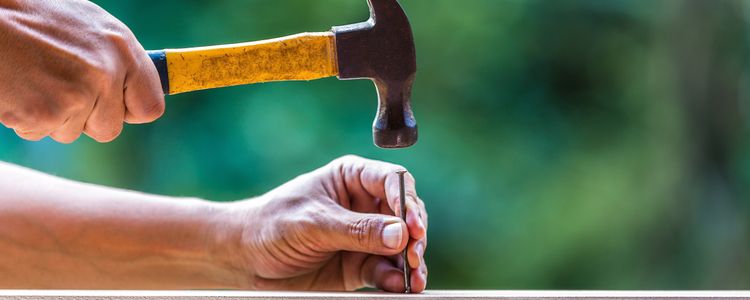
Nailing
The easiest way to connect wood to wood is by using nails. The only tool you need is a hammer. Nailing is a suitable method for connections on which there is not much pulling power. A hardboard rear wall of a home-made cupboard, for example, or a garden fence.
A few tips
- Some types of wood split quickly, and the thicker the nail, the greater the risk. When using soft wood, you can first place the head of the nail on the wood and tap the point with the hammer to create a small dent.
- Use the right size and nail for every job. A rule of thumb is that a nail must be two to three times as long as the thickness of the part you want to connect. Also always nail the thinner material to the thicker instead of the other way around.
- When connecting heavy planks, such as garden fences, it is best to use ring nails: nails with ring-shaped ridges that provide extra grip. For garden fences and other outdoor material, opt for stainless steel nails or galvanized nails.
- By tapping the nails at a slightly different angle into the wood, you get a stronger connection.
- You prefer not to have visible nail heads? Then use casing nails and sink them with a punch. Aftwerwards, you can fill the holes with liquid wood.
Screwing
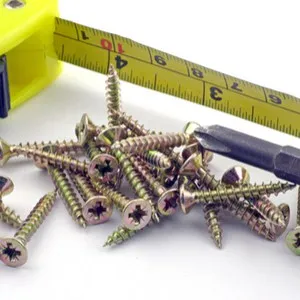
Screws provide a stronger connection than nails, because they are not easily pulled out of the wood thanks to the thread. What’s more, the job can be done quickly with a screw drill. Screws come in even more shapes and sizes than nails, and one of the things to look out for is that you use the right bit for the screw head.
In addition to wood screws, there also are special chipboard screws. The difference is that with chipboard screws the thread extends all the way to the head and with wood screws not fully.
Screw tips
- Especially with thicker screws, it is advisable to pre-drill the hole first. Use a drill bit that is 1 to 1.5 mm smaller than the diameter of the screw.
- At least half of the screw must penetrate the thicker wood. When dealing with a heavy load, two-thirds is even better.
- Using screws in combination with glue will guarantee an even stronger connection.,
- By using a counterboring tool, you can make a hole in the wood in which the screw head is galvanized. You can then hide the hole with filler or liquid wood.
Glueing
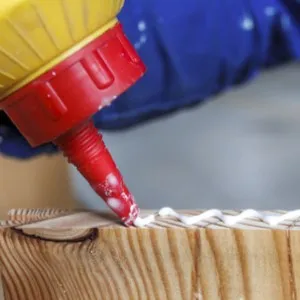
There are various adhesives that are specifically intended for wood, or that can be used for both wood and other materials. The most common are:
- PVA (Polyvinyl acetate) glue. This is the well-known white wood glue that dries in a transparent way. It is traditionally used for furniture. In addition to the normal PVA glue, there also is a fast-curing variant and a water-resistant variant.
- PU (Polyurethane) glue. This construction glue is particularly strong and waterproof. In addition to wood connections, this can be used for gluing wood on stone, concrete, metal and various plastics.
- Contact adhesive. With contact adhesive, you can glue all kinds of materials, such as wood, formica, cork, leather and plastic. There are many different types, including adhesives with which skirting boards and scraps can be easily attached to all kinds of surfaces.
- Two-component adhesive or resorcinol glue is the preferred type of adhesive for applications where the highest demands are made at the wood connnection. It is resistant to heavy loads and is used in shipbuilding, among other things.
Glue tips
- Make sure that the surfaces to be glued are free of dust and grease and flat enough so that they touch each other over the entire surface.
- If possible, clamp the connection with glue clips, and only remove them when the glue has completely hardened.
- You can also use screws or nails for this, which makes the connection extra strong.
- Sandpaper the ends of the of planks as smooth as possible before gluing them, this will create a better adhesion.
Metal anchors
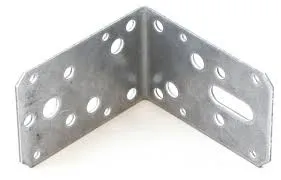
There are various tools for mounting boards and sheet material at right angles. Most are not suitable for bearing structures. Two types that can be used for this are corner anchors and beam support brackets.
- Corner anchors are used, for example, to connect beams to each other. They are steel corners with screw holes.
- Beam support bracket serve to attach a beam with the front side to another beam.