When renovating or moving into a new home, it may be necessary to install new electricity cables or to change the course of the wiring. Of course we do not want any wires in sight, so the cables run neatly through PVC pipes in the wall or under a cable duct.
We collected the best wire pulling tricks to make your job easy and avoid any unnecessary risks.
For pulling cables you need:
- Stripping pliers
- Tension spring
- Lubricant
Tension spring
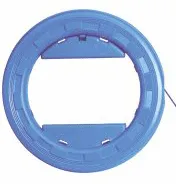
A tension spring is a long, thin spring of steel or fiberglass which looks like a fish wire. The length can vary widely: there are springs of 5 meters, but also 50 meters for longer distances. On the end is an eye, to which the cables can be attached. You then push the spring through the tube until it comes out on the other side. When you pull it out completely, the wires are in place. A perfect spring for cable pulling.
A job for two
Drawing cables is best done by two persons: one at the entrance side to ensure that the tension spring moves smoothly and without any kinks into the tube, and one at the point of destination to pull the spring outwards. This should be done with small jerks, always waiting for a signal from the other side.
Pulling cables in 3 steps
1. Push the tension spring through the tube as described above. If it moves very roughly, applying some lubricant will help. There are special cable lubricants for sale, but products such as talc, detergent or WD40 also do the trick.
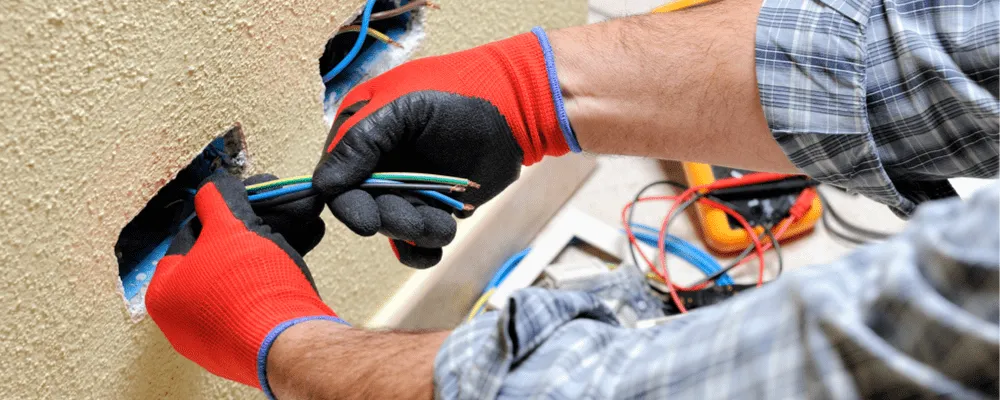
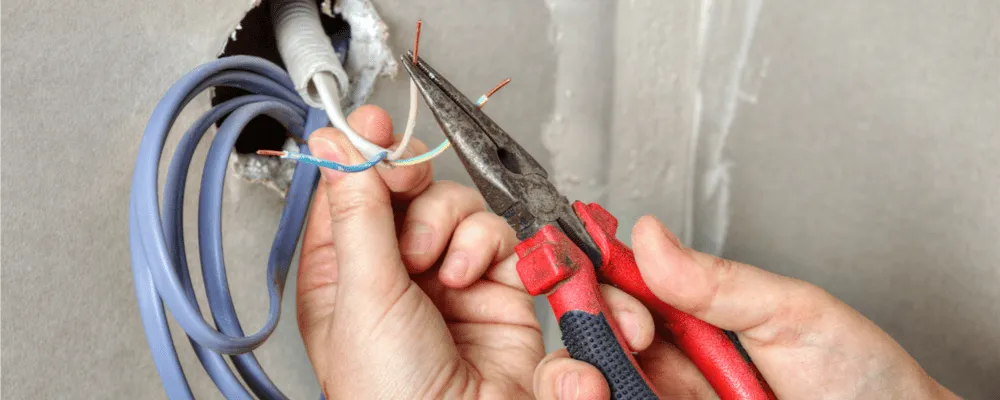
2. Fasten the wires to the eye of the tension spring. Strip them first with stripping pliers, and fix them so that there is no knot that can get stuck in a bend. Pull all the wires you need in one go through the tube, because adding a wire later is difficult, and you run the risk that the tension spring damages the existing wires.
3. Ensure that the cables protrude sufficiently. This works easier when mounting a switch or socket, and the excess can always be cut off.
Tip: Drawing cables is about the last thing you do when renovating, after all is bricked up and there is no risk of damage. It is also recommended not to pull cables at temperatures below 5 ° C, because low temperatures make the cable jacket tighter and therefore more vulnerable.
In this video you can see exactly how you work when pulling cables.
Pulling a cable through a pipe with existing cables
Pulling a cable through a tube in which already cables are running is not easy. You can use one of the existing cables to pull the new cable. Tie two cables at one end, one that is equal to the existing cable and the pulled wire right. Now pull the cable out of the tube on the other side. If the operation succeeds, you have your new cable where you want it. If it does not work, then there is no other option to solve the problem than to pull all the cables out of the tube and re-enter them, together with the newcomer.
Legal requirements
There are legal safety regulations for the installation of conduct pipes and the maximum number of cables that can be run through a pipe.
If you apply the tubes yourself, then fasten them firmly with cable clips. Tubes must not come loose, because then the wiring can be exposed.
The maximum number of wires in a tube depends on the type of pipe. Less wires can be drawn in a flexible tube than in a rigid tube. To start from the most common situations:
– a 16 mm rigid tube may contain 5 wires of 1,5 mm² or 4 wires of 2,5 mm²
– a 16 mm flexible tube 4 wires of 1,5 mm²or 3 wires of 2,5 mm²
– a 19 mm tube (stiff or flexible) 5 wires of 2,5 mm²
A tube may only be used for one group. If you need more groups – for household appliances, for example, which each have to be connected to a separate group – then you will have to use a separate pipe for each group.